The cornered beast is preparing the worst for the peoples of the planet!
The report on the "US National Security Strategy" published last November reflects—to the extent that this is possible—the directions that the Trump administration considers necessary for American imperialism. The "extent to which this can be done" does not only concern the obvious issue that specific political, military, and economic moves and choices planned and prepared within the US administration's staff are not pre-announced or published. We would say that it mainly concerns two other factors that we believe played a decisive role in the drafting of the report, as the Trump administration completes its first year of its new – second – term.
The first and fundamental factor is the problems faced by the world's leading imperialist power. A web of issues that "start" with the conditions for establishing and strengthening its economic and industrial base, strengthening and expanding its energy and technological superiority and the global primacy of the dollar, and "reach" the issue of maintaining and expanding the vast global network (or complex, as the report calls it) that is "military, diplomatic, secret" and necessary for "foreign aid," i.e., for the plundering and control of the planet. Ultimately, a web of issues that can be summed up as "the mismatch between goals and available means," as we have been saying since the 1990s. This mismatch has become much more acute over the decades and has highlighted, in the most compelling way, critical issues for American imperialism in terms of its choices and priorities vis-à-vis its rivals and allies.
For the web of these issues and the multitude of increasingly acute contradictions they produce, the Trump administration does not (cannot) have a "comprehensive" and, above all, "certain" answer. Furthermore, it is evident, even in dramatic and fierce ways, that for years now there have been fierce debates within the dominant centers of the US about the choices that must be made to address this complexity of issues. This, then, what we might call the "objective problem" is also a fundamental limitation of the directions that the November report could take.
The second factor that limited the content of the report was the search for a so-called "peace plan" for Ukraine. These limits did not only concern "diplomatic" propaganda needs that prevent the Trump administration from presenting Russia as a strategic adversary at a time when it is seeking some kind of temporary agreement with it. These limits mainly concern the very essence of American aspirations in the negotiations that are taking place and, ultimately, whether and what will come of them. Thus, at almost the same time that American media reports confirm that the attacks by Ukraine on the Russian fleet in the Black Sea and the Mediterranean were organized and directed by the CIA, the report highlights the goal of "a rapid cessation of hostilities in Ukraine," which cessation (rather than termination) "will restore strategic stability with Russia." The disruption of "strategic stability" between the US and Russia is obvious and a given, given the developments on the Ukrainian front. But the real solution to the impasse for the US, or rather, its real strategy towards Russia, is stated earlier in the report, where it emphasizes the need to "restore conditions of strategic stability across the Eurasian landmass." which in turn presupposes "significant US involvement" in Europe-Russia relations. Despite the "discretion" of the wording, such a goal can only be described as a "withdrawal" or at least a "disengagement" of the US from Ukraine and Eurasia!
However, even with these limitations, the report certainly sets out and reflects a basic framework of the goals and aspirations that the Trump administration has formulated for American imperialism. Let's look at some key points.
"America in danger!"
The report's description of the US's general "wants" is full of negative terms, or, in other words, goals about what shouldn't happen:
"No adversary or threat should be able to keep America at risk." "The United States cannot allow any nation to become so dominant that it could threaten our interests." "We must prevent the global, and in some cases even regional, dominance of others."
These definitions are important because they reflect how the US military leadership perceives all the issues that constitute what we call the "relative decline of the US" vis-à-vis its rivals and competitors. And, of course, we believe that this approach is common ground among all the opposing centers within the US. It is their common reading of the current situation and their shared and genuine concern about how to reverse the course that led to the "cornering of the beast" in terms and circumstances that they did not anticipate at all after their victory in the Cold War, which was sealed with the collapses of 1989-91.
Furthermore, the report we refer to also contains important retrospective data on how things have developed in this way from the 1990s to the present day. This retrospective data concerns both opponents-competitors and allies-competitors.
The reference to the China issue and the responsibilities of "both political parties" – i.e. Republicans and Democrats – for this course of events is direct and straightforward:
"President Trump single-handedly overturned more than three decades of misguided American assumptions about China: namely, that by opening our markets to China, encouraging American companies to invest in China, and outsourcing our manufacturing to contractors in China, we would facilitate China's entry into the so-called 'rules-based international order'. That did not happen. China got rich and powerful, and it used its wealth and power to its advantage.
We believe that Russia (which, of course, the US has always kept out of Western markets, but which nevertheless had "access" to the West through the Ostpolitik) is subject to similar (self-)criticism regarding the misjudgments about the dynamics of its reconstruction, which, however, are not expressed due to the current situation or, more accurately, because they cannot be expressed. criticisms regarding the misjudgments about the dynamics of its reconstruction, which, however, are not expressed due to the current situation or, more correctly, because weaknesses concerning the open and strategically important Ukrainian front cannot be admitted.
Less direct, but clear, is the criticism of the US's political actions on the issue of the terms of its alliance with "Europe":
"And they tied American policy to a network of international institutions, some of which are guided by overt anti-Americanism and many by an internationalism that explicitly seeks to dissolve the sovereignty of each individual state."
This position (stated right at the beginning of the report on page 2) is the basis of a policy that puts an end to "all together" and demands "the US in front, you follow in the roles we assign you." But since we will return to the issue of US-EU relations as currently demanded by the US, let us conclude this section with a conclusion:
By identifying and describing the above risks which the US faces, the report establishes the rationale for the strategy it subsequently presents. A strategy which, based on the "diversity of interests" of the US in the four corners of the globe, could be summarized as a generalized and escalating attack that will weaken and neutralize its opponents, after first "recruited" imperialist allies, regional powers, and dependent countries to the US's goals! If this framework is vague in its generality (and indeed it is), it becomes much more specific in its individual goals. In any case, the primary and most important goal of this scheme is to shape the internal front of the US from top to bottom, in line with the Trump administration's policy. Moreover, for the "lower" part of the front, the working class and the people, a series of fascist measures are already being promoted to command it as required by the needs of the cornered beast.
"The Western Hemisphere is ours"
According to the report, the basis and necessary prerequisite for the success of this generalized and escalating attack is complete control, the "conquest" by the US of the entire Western Hemisphere! This is an extension of the Monroe Doctrine (which concerned control of the American continent) and that is why the American media have christened it the "Donroe Doctrine."
Of course, control and "conquest" of the hemisphere "begin" with control and "conquest" of the American continent. All the aspirations expressed by the Trump administration regarding Canada, Mexico, and the Panama Canal are understood and are part of this plan. Even more so is the goal of clearing Latin America (considered the "backyard" of the US) of competitors, rivals (Russia, China), and their European allies. The US intervention in Venezuela (which has significant military support from Russia and important energy ties with China and Iran), which is unfolding as these lines are being written, is absolutely characteristic of the brutality and cynicism of American plans.
The report characterizes the current situation in the Western Hemisphere, and particularly in the American continent, as negative for the US, as the result of unanswered "invasions":
"Competitors outside the Hemisphere have made significant inroads into our Hemisphere, both to put us at an economic disadvantage in the present and in ways that could harm us strategically in the future. Allowing these incursions without serious resistance is another major American strategic mistake of recent decades."
On the basis of this criticism, he sets out a course for the immediate future:
"After years of neglect, the United States will reaffirm and enforce the Monroe Doctrine to restore American supremacy in the Western Hemisphere and protect our homeland and our access to key geographic areas throughout the region. We will deny competitors outside the Hemisphere the ability to deploy forces or other threatening capabilities or to possess or control strategically vital assets in our Hemisphere. This "Trump Corollary" to the Monroe Doctrine is a common-sense and robust restoration of American power and priorities, consistent with American security interests.
The whole plan is clear: in order to compete with and ultimately crush their imperialist rivals (Russia and China), the US must first exclude them from any penetration into the Western hemisphere, and it (the US itself) will need to control/possess every source of wealth, every geopolitical and geostrategic opportunity that the hemisphere can provide. In this sense, the annexation of Greenland (which American officials often threaten with all kinds of threats) is also on the agenda, as it is an "extension" of the American continent and a critical geostrategic base against Russia.
Of course, what reactions each step in the implementation of this ambitious plan will provoke, and whether it is feasible, is "another matter"! For example (to mention just one critical aspect), whether and how all the countries and governments of Central and South America can be "recruited" (as the report actually calls for) to MAGA!
China and its "chains"
The report highlights the strategic importance (economic, commercial, geostrategic) of the Indo-Pacific, linking it directly to US-China competition. It identifies two target directions for the successful—for the US—development of this competition.
First, the "recruitment" of US allies at the economic and commercial level to address a key problem identified in the report:
"The United States imports Chinese products indirectly through intermediaries and Chinese-owned factories in twelve countries, including Mexico."
In order to block this export activity by China, which concerns high value-added products, it is seeking a common economic plan with those it defines as allies for the so-called Global South:
"The United States and its allies have not yet formulated, let alone implemented, a common plan for the so-called 'Global South', but together they have enormous resources at their disposal. Europe, Japan, South Korea, and other countries hold $7 trillion in net foreign assets."
Furthermore, the report makes no secret of the fact that the US wants to return China to the levels of capitalist development it enjoyed decades ago, when the US and the West welcomed it as an important factor in their competition with the then socialist-imperialist USSR:
"We must encourage Europe, Japan, Korea, Australia, Canada, Mexico, and other prominent nations to adopt trade policies that help restructure China's economy toward household consumption, because Southeast Asia, Latin America, and the Middle East cannot absorb China's enormous excess production capacity on their own."
However, because the Trump administration (and US policymakers in general) understand that these goals cannot be achieved through trade, tariff, and economic "wars" in front of this first goal, the report highlights the second goal-direction of the US towards China: its geopolitical and military encirclement, its confinement behind the two island chains, so that it does not have its own "living space" or the necessary base for geostrategic control of the region. A single excerpt from the report—one of many—is enough to show how decisively this direction is being pursued:
A favorable conventional military balance remains an essential component of strategic competition. There is, rightly, a strong focus on Taiwan, partly because of Taiwan's dominance in semiconductor production, but mainly because Taiwan provides direct access to the Second Island Chain and divides Northeast and Southeast Asia into two separate theaters. Given that one-third of global shipping passes through the South China Sea annually, this has significant implications for the US economy. Therefore, preventing a conflict over Taiwan, ideally by maintaining military superiority, is a priority. We will also maintain our long-standing policy of no change in the status quo in the Taiwan Strait. We will build a military capable of denying aggression anywhere in the First Island Chain. But the U.S. military cannot and should not be required to do this alone. Our allies must step up their efforts and spend — and more importantly, do — much more for collective defense. America's diplomatic efforts should focus on pressuring our allies and partners in the First Island Chain to allow the US military greater access to their ports and other facilities, to spend more on their defense, and, most importantly, invest in capabilities aimed at deterring aggression. This will link maritime security issues along the First Island Chain, while strengthening the ability of the US and its allies to deny any attempt to seize Taiwan or achieve a balance of power so unfavorable to us that it would make it impossible to defend this island.
We believe it is clear that the US policy of "no unilateral change in the status quo in the Taiwan Strait" does not concern their own plans for Taiwan's independence-secession (which remain), but their opposition to China's plans to integrate Taiwan. And it highlights Taiwan as a decisive base-tool of the geostrategic suffocation that the US seeks to impose on China. Of course, in this area too, the US objectives as set out in the report are grandiose or at least uncertain. Among other things, they presuppose the recruitment of a series of allies (among whom the US would like to include India) who cannot be taken for granted. On the other hand, Beijing is not standing idly by in the face of all this, as developments in recent months have shown, from the Tianjin Summit at the end of last August to China's recent large-scale military exercises with live ammunition in the Taiwan area.
"A strong Europe—our obedient assistant"
The alliance between the US and European imperialists is the most fundamental element of the entire post-war period. It is the backbone of NATO and the West, the victors of the Cold War. A victory based on the strategic (nuclear) coverage of Europe by the US. A victory that drastically changed (in favor of the West) the geopolitical situation in Eurasia, which was the main theater of the two World Wars and is still today the focus of global imperialist competition. A victory that paved the way for NATO's rapid expansion eastward.
However, this fundamental relationship underwent significant and even critical distortions in the decades following 1990. These distortions manifested themselves in the euro and the ambitions of European imperialists, who used the EU as a vehicle to claim an upgraded role on the world stage, in contrast to the US, which wanted "all to themselves" the "golden opportunity" of victory in the Cold War. These distortions were exacerbated by the ost politic, which, on the one hand, served as a basis for strengthening the European imperialists, but, on the other hand, served as a factor in strengthening Russia's reconstruction process, especially after 2000. This led to the rift of 2003 (Iraq), the construction of the two northern pipelines to supply Europe with natural gas from Russia, and even Macron's statements about NATO being "brain dead."
The war in Ukraine has largely eliminated these distortions, in line with US objectives. Pipelines were blown up, and European imperialists were "ordered" to confront Russia. At the same time, they were immediately confronted with their strategic deficits and the need to acquire greater military weight, as emphasized by US demands, as formulated in the 5% for NATO. Nevertheless, distortions have not been completely eliminated, as the report points out:
"Today, German chemical companies are building some of the world's largest processing plants in China, using Russian gas that they cannot obtain at home."
Furthermore—and most importantly—the current developments in the war have created a potentially dangerous complication for the US in terms of its relations with the European imperialists. The tactical respite they are seeking ("cessation of hostilities") in Ukraine must be such that it leaves no room for a return to previous European-Russian relations, in this case Putin is constantly intensifying his war on "anti-Russian European hysteria" and promoting the direction of "a new security architecture for Europe." The question, therefore, for the US is what role it will find and give to the Europeans in the context of a "cessation of hostilities," if and when this occurs. A role that, on the one hand, will bind them and keep them consistent on the anti-Russian front and, on the other hand, will ensure that no further steps are taken towards a central confrontation (for which neither the US nor Europe is ready), that, in the words of the report, "strategic stability with Russia" will be preserved.
We believe that all of the above are reflected in the letter and spirit of the report, as far as each of them can be reflected. Thus, the report is more than clear and straightforward about the strategic importance of Europe for American imperialism, while at the same time making no secret of the fact that it views Europe as an ally of the US in its plans:
"... we cannot write off Europe – that would be self-defeating for what this strategy aims to achieve." "We will need a strong Europe to help us compete successfully and work with us to prevent any rival from dominating Europe."
Thus, while the report does not fail to hint at the concerns of the US (or at least of the report's authors) about Europe's relations with Russia, pointing out that " the lack of self-confidence is most evident in Europe's relationship with Russia," it is clear that it has chosen a tough and demanding line towards its European allies, considering that the "concessions" of previous US policies have undermined its strategic objectives. Or, as we have already mentioned, the report proposes the approach of "we come first and you play the roles we assign to you," even if this is to the detriment of your interests.
This is particularly evident in the critical issue of energy, where the report declares (as has already been done with shale gas, but also with US supremacy in the Middle East) that the US rejects all commitments to "green energy" that were so convenient for European (German) industry. Let's look at the relevant excerpt from the report:
"Restoring American energy dominance (in oil, natural gas, coal, and nuclear energy) and rebuilding the necessary basic energy components is a top strategic priority... Expanding net energy exports will also deepen relationships with allies, while limiting the influence of adversaries, protect our ability to defend our shores, and—when and where necessary—allow us to project power. We reject the destructive ideologies of "climate change" and "Net Zero" that have so damaged Europe, threaten the United States, and subsidize our adversaries.
Another characteristic feature is the reference to the prospects for US-European relations in terms of blackmail:
"We want to work with like-minded countries that want to restore their former greatness.
In the long term, it is more than likely that within a few decades at the latest, some NATO members will become predominantly non-European. Therefore, it is an open question whether they will see their place in the world or their alliance with the United States in the same way as those who signed the NATO charter."
By "non-European," the report means "outside the EU," anticipating the EU's decline and their forced (as it wants to portray it) alignment with the US. An alignment that is implied to be better done now than later!
War is coming—people, beware!
The report, of course, also refers to other critical areas of imperialist competition (the Middle East, Iran, Africa), where, despite the boasts about "Trump's successes," even in "second place," it does not shy away from acknowledging that the goals set by the US remain open and up for grabs. The issue of Iran is far from being decided in favor of the West and the US, in Syria the success of Assad's overthrow does not seem to be able to be completed in a stable American hegemony, and the Abraham Accords remain mired in the blood of the genocide of the Palestinian people, who persist on the path of resistance. As for Africa, its many wounds are being exploited simultaneously and contradictorily by rival imperialists.
We will omit more specific references to all this and, considering that we have provided the basic elements of the "US National Security Strategy" as submitted last November, we will conclude with some brief conclusions.
- The cornered beast, bound by its imperialist nature and confirming it, declares a war campaign on the planet. It cannot and will not relinquish its top position, its goal of global hegemony/domination, and is pursuing the most cynical, barbaric, and opportunistic options. The Trump administration is one version of this path – previous (Democratic) administrations were also on the same path. The tactical modifications of these versions are important, but they do not change the direction and essence of the issue: the US is the greatest enemy of the peoples, it is the force leading the way in the preparations for war on the planet.
- The rivals of the US imperialist powers (Russia, China) are equally bound by their imperialist nature, responding and continuing to respond in every possible way to the choices and aspirations of the US. They cannot and will not renounce their ambitions, setting aside everything they have built and shaped over previous decades in order to achieve their current goals. Second-tier imperialists (Europeans and Japan) have and will continue to have similar characteristics and attitudes. Their complementary role in relation to the geostrategic triad can only intensify their opportunistic tendencies.
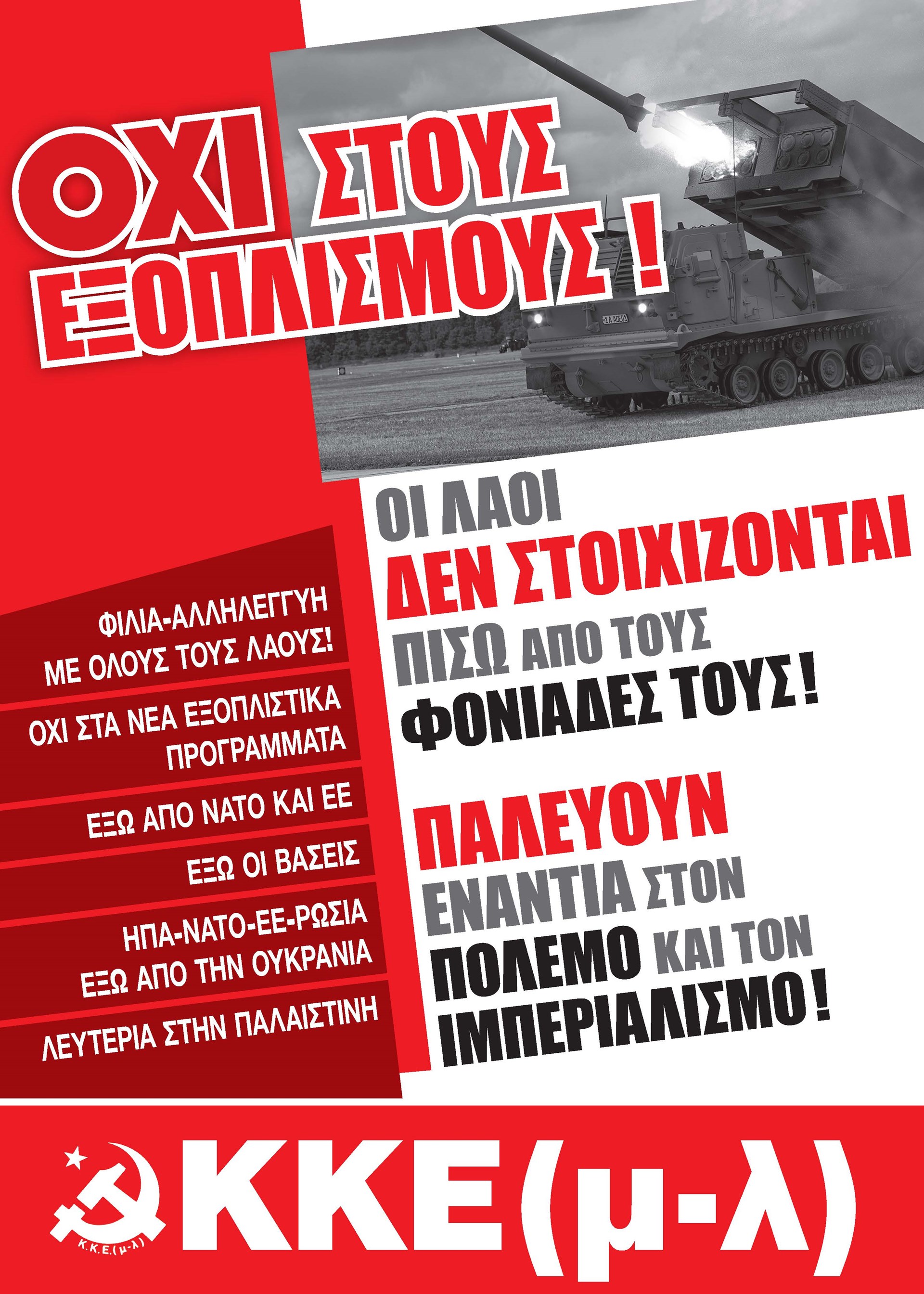
This intensification of imperialist rivalries, which is mutually reinforced with the generalized capitalist crisis and as each side seeks—in opposition—conditions and answers, will increasingly produce events that were that were "unthinkable" until yesterday, such as the current US intervention in Venezuela. In other words, the planet is becoming – and will increasingly become – a battleground for global war, and global production will be shaped mainly by monstrous armament programs (conventional and nuclear weapons), spearheaded by the geostrategic triad and followed by second-rate imperialists, regional powers and dependent countries.
- Within this landscape and in order to serve it, policies of exploitation and impoverishment are escalating, while at the same time (starting from the imperialist centers, with the US at the forefront) fascist policies of oppression and suppression of the freedoms of the masses are escalating.
- The working class and the peoples of the world do not have and cannot find allies who will stand up to this course within the imperialist powers and the bourgeois classes. The proletariat and the peoples have both the need and the power to sound their own alarm, to organize their own anti-war and anti-imperialist struggle. This is the only real possibility, the only real hope and way out for the working masses.
06/01/2026
The Secretariat of the Central Committee of the KKE(m-l)

(Το βίντεο αναρτήθηκε ξανά μετα απ΄ την διόρθωση των ηχητικών προβλημάτων που υπήρξαν)